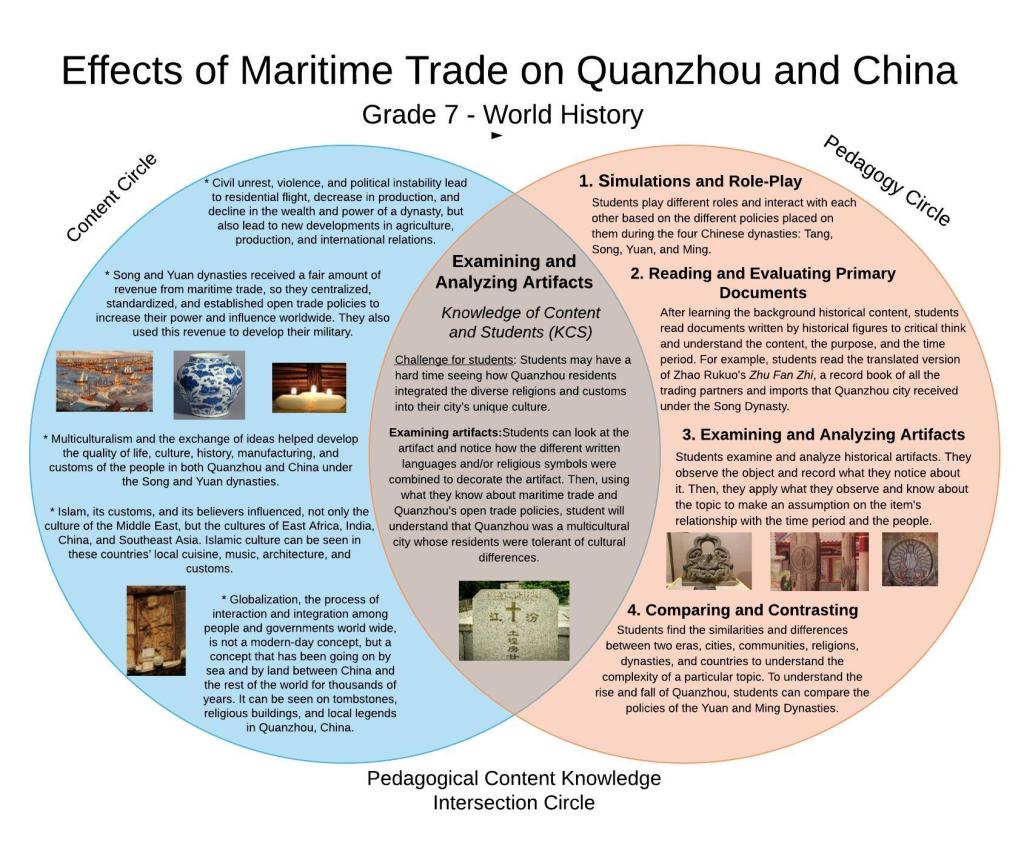
Pedagogical Content Knowledge Venn Diagram
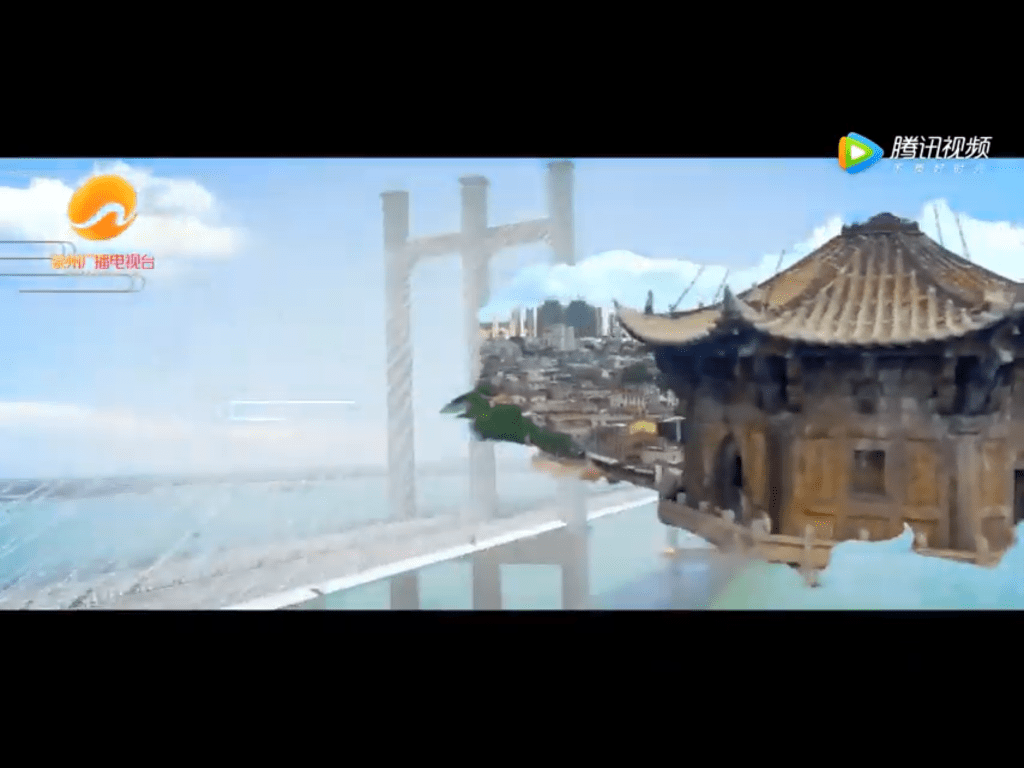
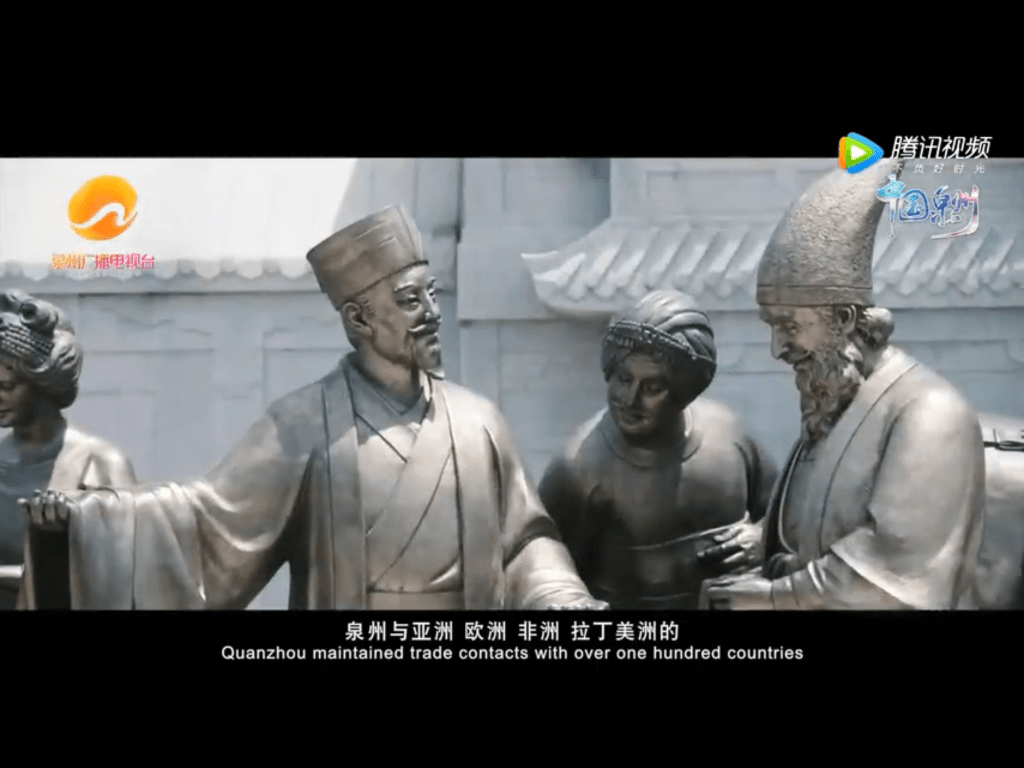


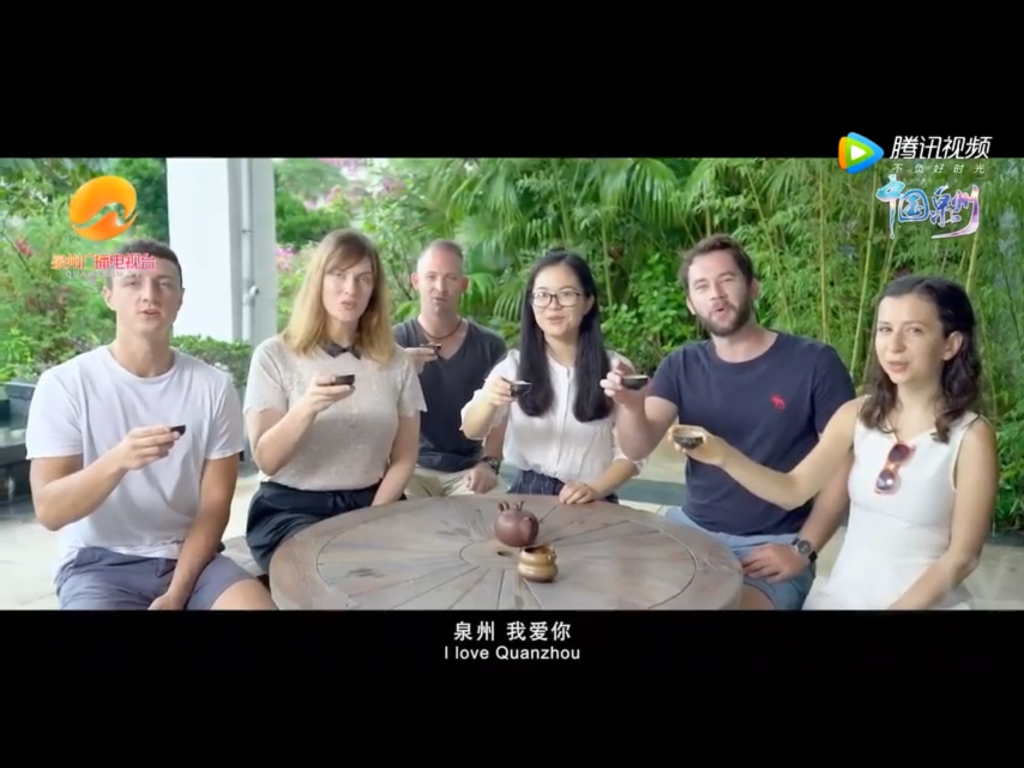
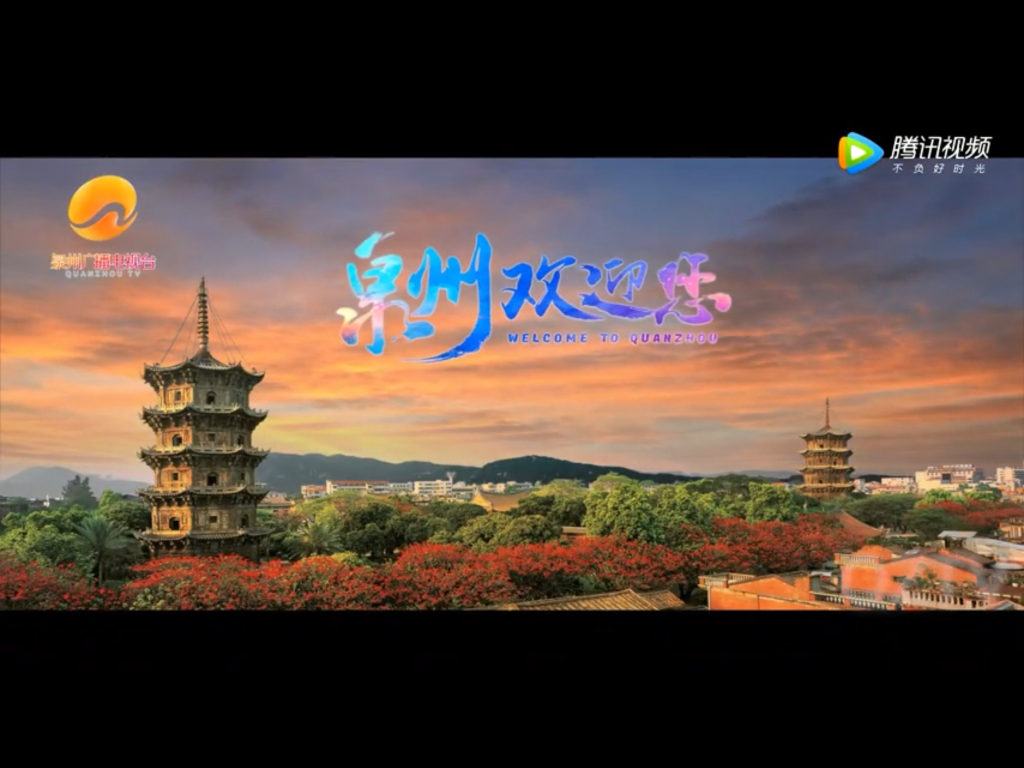
This short ten-minute video is a promotional video for the city of Quanzhou. First, the video explains Quanzhou’s ancient history. Under the Song and Yuan dynasties, Quanzhou was both a huge maritime trade port as well as a city with many religions and ethnic groups co-existing peacefully. Since the city has maintained their historical sites and cultural relics so well, the city is listed in both the Cultural Heritage List and Memory of the World Register. Second, the video explains how Quanzhou has been a pilot city for China’s “real economy”, which promotes and expands private industries. Quanzhou has several major industries: textiles garments, shipbuilding, footwear, home furnishing, petrochemical, and mechanized equipment. The surrounding areas are also doing well in growing tea, designing ceramics, and making aromatics. The video concludes that Quanzhou is a city that strives towards industrial transformation and technological innovations.
Although this isn’t related to my guiding questions, it was interesting to learn that Quanzhou and Fujian’s local Chinese population under the Song and Yuan dynasty created special types of music. Known as the “living fossils”, these musical styles include Nanyin music and Liyuan opera. The Nanyin includes the playing of local instruments and lyrics from the local Fujian dialect.
I watched this video because I wanted to see how much of the old Quanzhou is present in the modern-day Quanzhou. It still is. Like the Quanzhou that was ruled under the Song and Yuan dynasties, modern-day Quanzhou relies on manufacturing and cash crops to boost its economy. Quanzhou and its surrounding areas manufactures ships, grows tea, and designs textiles and ceramics, like Quanzhou did under the Yuan Dynasty. Of course, modern-day Quanzhou has expanded its industries to include manufacturing buses, creating home furnishing, and designing footwear. From 900AD to 2017 AD, Quanzhou is a city that strives towards industrial transformation and technological innovations.
YANG, J. (2018, September 7). 中国福建泉州2017城市宣传片(China Quanzhou 2017 City Promotional Film) [Video]. YouTube. https://youtu.be/cTWCdHqS3Dc
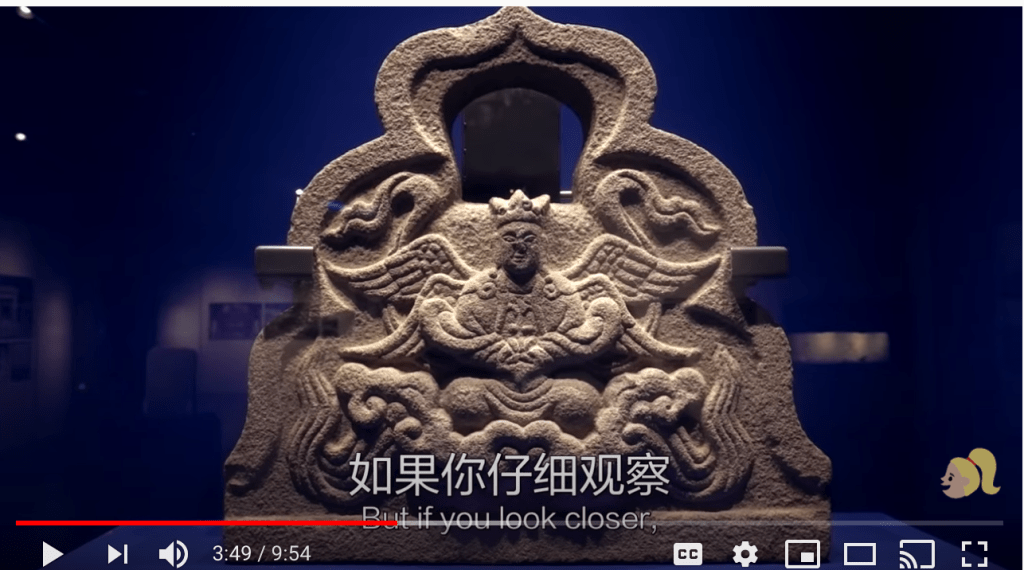
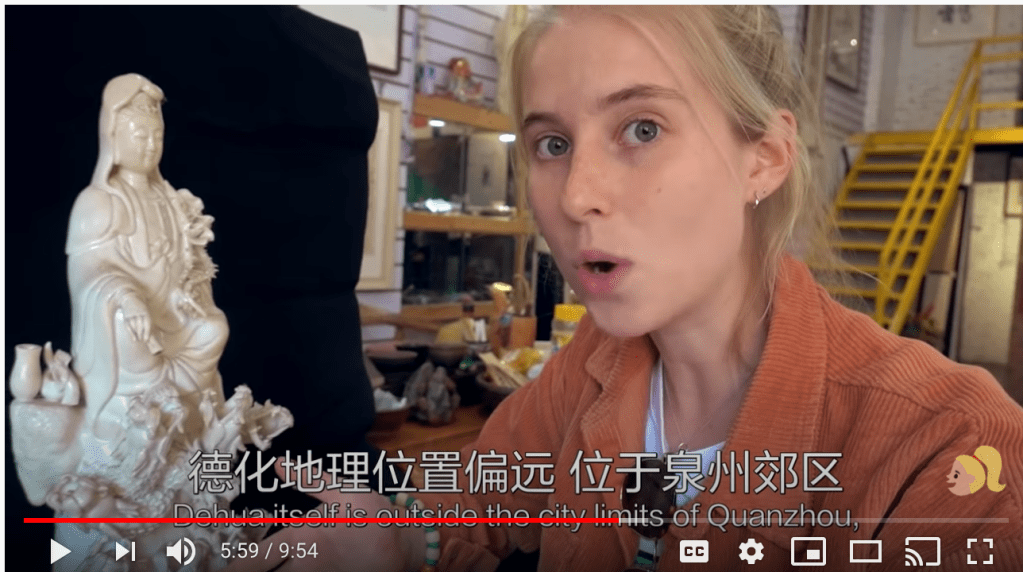
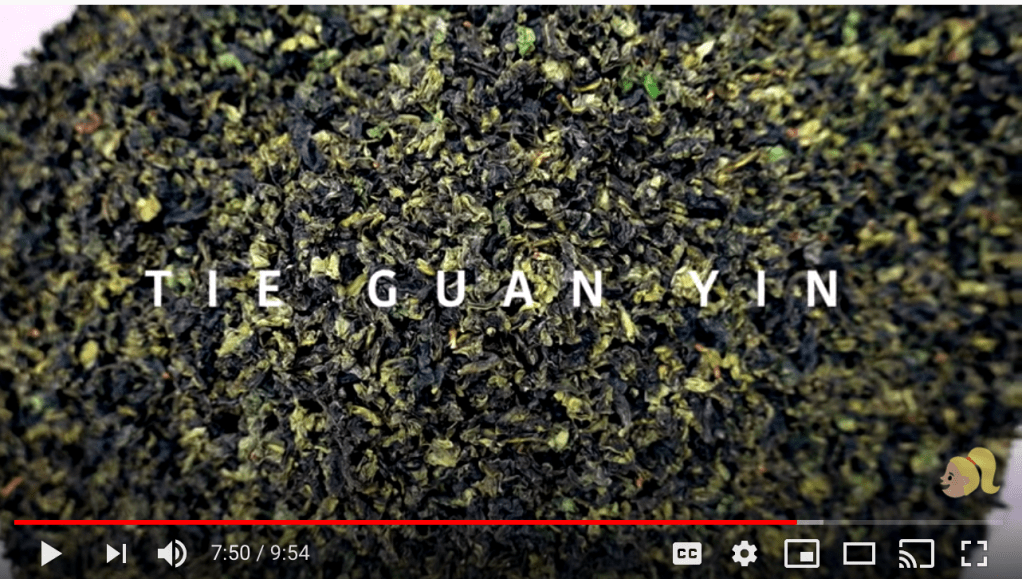
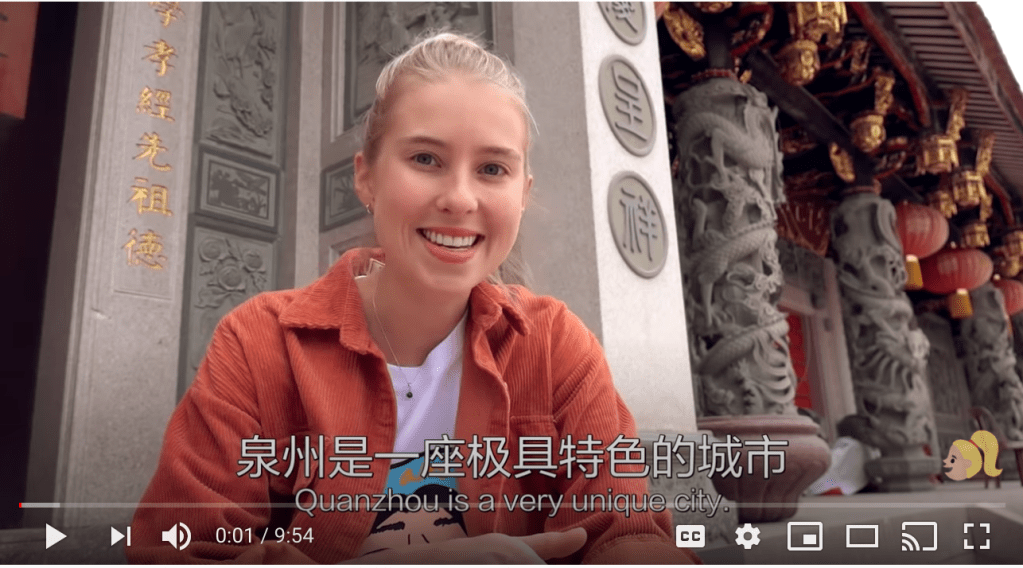

An Australian Youtuber, Amy or “Blondie”, who has traveled and lived in China for five years, presents an informative overview about the culturally diverse city of Quanzhou. In this video, she first explains that Quanzhou was a cultural city that valued religious freedom and openness. While walking, she shows that the Qingjing Mosque, the Guanyu Temple, Quannan Christian Church, and Kaiyuan Temple are all a short walking distance from each other. In Quanzhou, she elaborates that you can see a mixture of religions through Hindu motifs on the Kaiyuan Temple’s two pagodas and the 4-Wing Angel carving that resides in the Quanzhou Maritime museum. She also discusses the popular items that Quanzhou exported around the world, which includes white porcelain made in Dehua and Tie Guan Yin tea produced in Anxi. From 900-1200AD, Dehua area, which is located in the outskirts of Quanzhou, produced white porcelain, which was sent around the world and known for its color and quality. It was a sought-after item by Europeans during the Ming dynasty. Tie Guan Yin tea was produced in Anxi, an area located in periphery of Quanzhou, and is still known for its sweet taste and nice fragrance.
There are a lot of interesting tidbits she discussed during this video. One of them was the everlasting multiculturalism of Quanzhou. Along the alleyways or houses, one can still see the Arabic influences. When asked about it, one staff member at the Quanzhou Maritime Museum explains that around 60,000-70000 of the Quanzhou population are descendants of Arabic maritime traders. Another interesting tidbit is the meaning behind the inscription on the stones on Jiuri Hill. According to Blondie, these inscriptions are prayers in the wind that wishes “travelers, traders, the businessman at that time safe travels, good winds, and smooth sailings”. Blondie believes this shows that Quanzhou loved the foreigners that came to Quanzhou.
This video answers both questions. It provides an explanation for the cultural and economic reasons why Quanzhou became a multicultural city. The cultural reason is that Quanzhou was open to foreigners, their culture, and their religions. Foreigners are more likely to stay in a place and make that place their home if the city and the community welcomes them. The economic reason is that the major exports that China gave the West was tea and porcelain, and those were developed in the periphery of the city. However, these two sites could have been created because Quanzhou was already a port city and developed sites closer to Quanzhou.
Blondie in China. (2019, December 19). Quanzhou: Where world cultures meet [Video]. YouTube. https://youtu.be/Ubs8a89sWL4
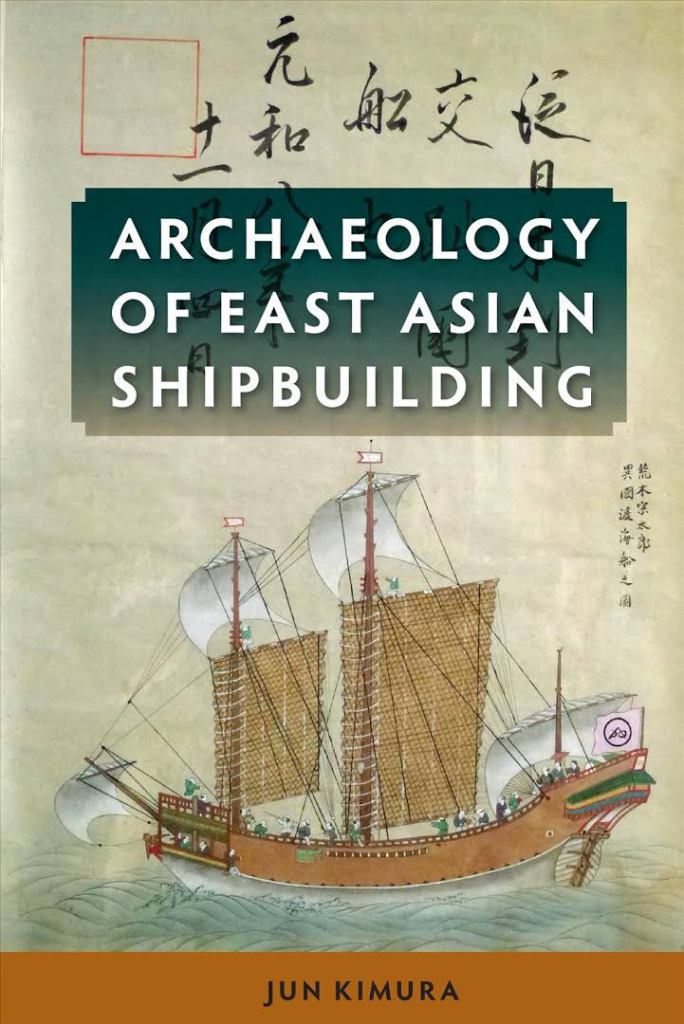
In the fourth chapter of the book, Archaeology of East Asian shipbuilding, Jun Kimura (2016) describes the construction and discovery of the sunken merchant ship found in the tidal mud flats off the Honzhu Harbour in the 1970s. Honzhu Harbor is one of the two harbors of Quanzhou city. The other one is Fashi. Archaeologists found that it was a ship constructed in the early 1270s under the Yuan Dynasty and sunk in mid-1270s. Maritime trade commodities were found in its cargo. The cargo contained scented woods and spices like pepper. The Chinese ceramics from the Song and Yuan dynasty that it had on board identified it as an Asian merchant ship. Through inspection, the ship was fairly new when it sunk and had no signs of repair. The cargo carrying capacity of this ship was around 200 metric tons. It could carry 50 people and some livestock. The design of the stowage space is suitable for small cargo items.
For the construction of the ship, Jun Kimura explains that the keel, the longitudinal structure along the centerline of the bottom of the vessel, was around 18 meters. He also mentions that the Chinese tradition of bao shou kong, which was the tradition of placing seven coins or coin holes with bronze mirror, was used in the scarf between the forward keel and mail keel. The characteristics of the bow and stern on this ship held general characteristics of Chinese warcraft. He continues that the ship’s haul planking demonstrated a complex structure and consisted of double and in part triple layered planking. Iron nails, not wood nails, were driven down diagonally and used to fasten the planks. Putty was used to protect the iron nails from erosion. The ship demonstrated an early use of iron clamps to tighten the plank tiers, which is a common Chinese ship building technique.
This chapter mentions that only 1% of the cargo remained on the ship. It could have been saved or taken before the sunken ship’s discovery in the 1970s. Wooden inked strips were found near the cargo on the ship. Archaeologists expect that they are tags to label the ship’s cargo. In addition to the cargo that was found on the ship, they found carpentry tools, ivory chess pieces, and chopsticks, which they expect were the crew’s personal items. I guess when the crew was on that ship, they ate with chopsticks, played chess, and used the carpentry tools to fix the ship if the ship needed some quick repairs.
This chapters answers my second question about the impact of multiculturalism or foreign traders had on Quanzhou. Because trade between foreign merchants and local Quanzhou Chinese residents was important investment in Quanzhou and the rest of China, Quanzhou spent a lot of time building trade ships. Many of these ships were privately owned by wealthy merchants. These wealthy merchants were also political leaders of the Muslim community. These ships had to be built to last long journeys and to protect their cargo. This sunken ship that was found is an example of one of those ships. Its cargo gave evidence of what was exported and imported. Its construction gave insight to the technology and craftsmanship of maritime shipbuilding.
Kimura, J. (2016). Quanzhou Ship. In J. Kimura (Author), Archaeology of east Asian shipbuilding (pp. 69-102). University Press of Florida. https://doi.org/10.1111/1095-9270.12215
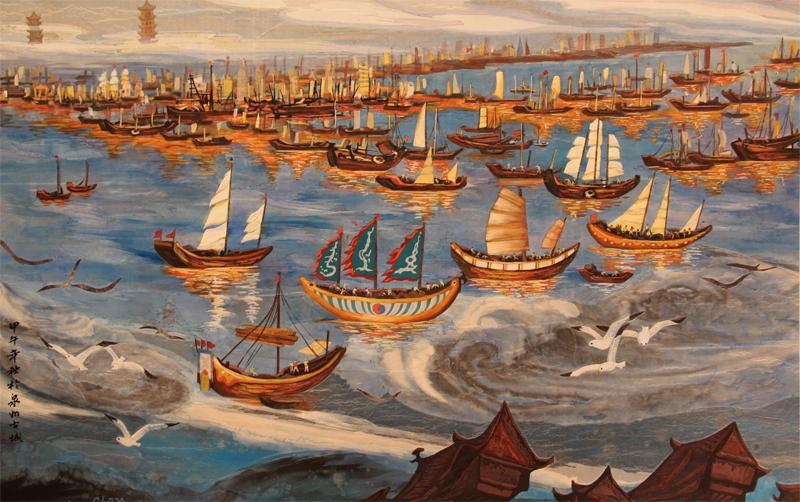
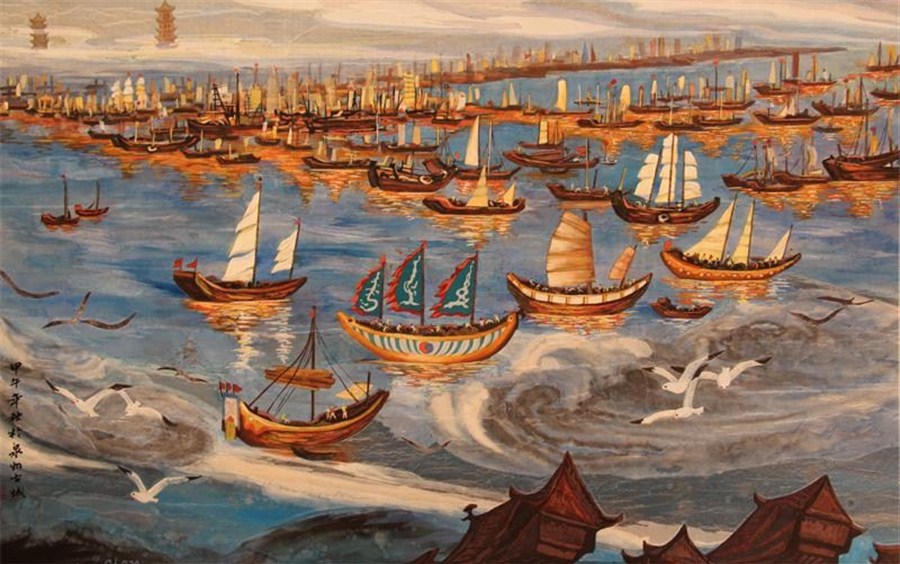
This painting depicts Quanzhou when it was major port city under the Yuan Dynasty. The painter and date of painting are unknown. In this painting, you see the vast amount of ships that docked and floated along the harbor. Each ship looks different, which means that they probably came from different areas. In the distance, you can see two pagodas, which are probably located in southern Quanzhou, where the foreign communities and Kaiyuan Temple are located. It looks like a great day in Quanzhou; the sea is calm, the wind is slowly guiding the ships, and the sun is setting.
One interesting tidbit of this painting is that it matches well with the observations made by Marco Polo about Quanzhou. Marco Polo wrote that when he visited Quanzhou there were vast amount of ships at the harbor. In this painting, the number of boats cannot be counted. I tried. This painting really illustrates how popular the harbor was in Quanzhou during this time period.
This painting is example of how popular the trade city of Quanzhou was during the Song and Yuan dynasty. Merchants ships from every region came to Quanzhou to trade. There were small-size, medium-size, and huge-size merchant ships that arrived at Quanzhou. This painting demonstrates that Quanzhou was definitely a center of maritime trade and therefore, a city that gave Yuan dynasty a lot of revenue to pursue its military and political pursuits. In addition, this painting shows evidence of foreign communities in Quanzhou. In the distance, you can see the Twin Stone Pagodas of Kaiyuan Temple. These two pagodas carry non-Chinese religious carvings and are located in Quannan. Historians think Quannan was the area where the foreign communities resided and is located near the harbor.
Municipality of Quanzhou. (n.d.). Quanzhou [Illustration]. UNESCO. https://archive.shine.cn/newsimage/2017/03/08/020170308170944.jpg
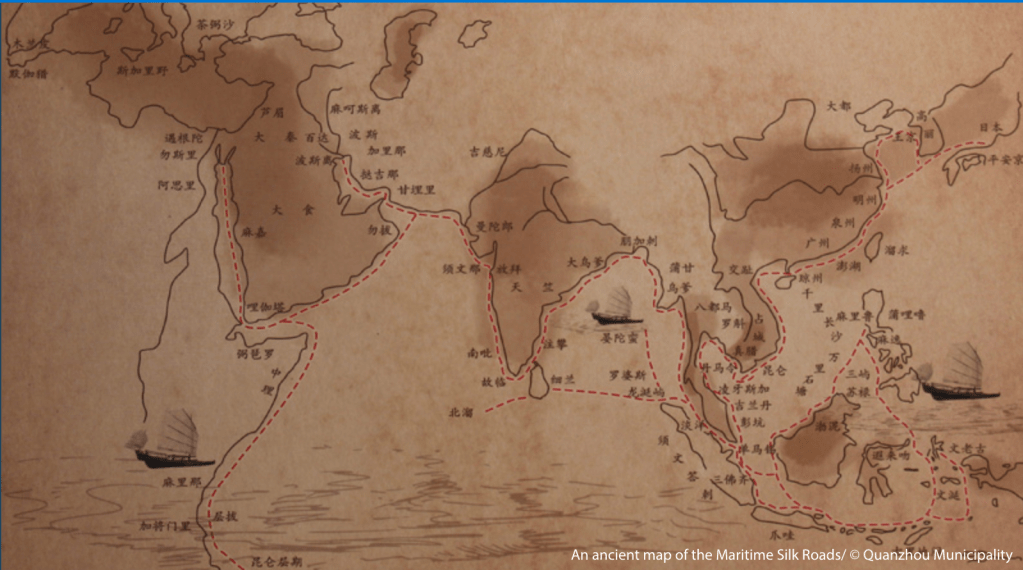
This is an ancient map of maritime silk trade routes. It shows the port cities written in Chinese and the trade routes that link them. From this map, you can see that maritime trade included East Africa, the Middle East peninsula, the Indian subcontinent, Southeast Asia, the Indonesian archipelago, East China, Japan, and Korea. This map also has illustrations of the merchant junk ships that Chinese merchants used. Unfortunately, the creator and the year this map was created are unknown.
From this map, you can tell which countries were close to and which countries were far from Quanzhou. Because of this distance, you can see why the Muslim merchants from Far West decided to stay in Quanzhou, and at the same time, you can see why Southeast Asia was a popular trade route for Chinese merchants.
This map can be used to explain why Quanzhou became a prime port city during the Song and Yuan dynasties. From this map you can see that it was close to sea and located between trading partner, such as the Korea, Japan, Vietnam, and Indonesia. In addition, this map also shows the location where the foreign merchant communities originally came from and where the Chinese merchants went when they traveled on the merchant ships built in Quanzhou.
Municipality of Quanzhou. (n.d.). An Ancient map of the Maritime Silk Roads [Illustration]. UNESCO. https://fr.unesco.org/silkroad/sites/default/files/styles/silkroad_colorbox/public/ map_pf_quangzhou_maritime_silk_roads_5.jpg?itok=D3Aoc64K

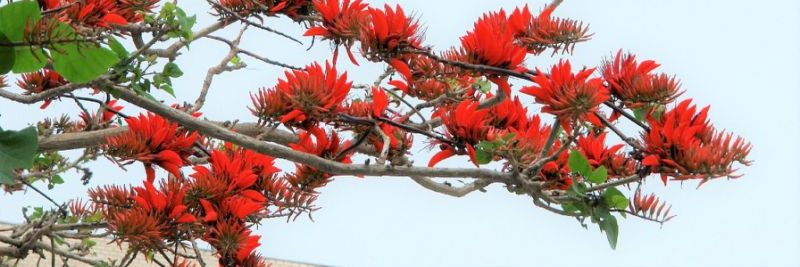
Silk Road Programme is a digital platform and website that presents information about the historical sites, artifacts, and ideas that spread along the old trade routes. It also aims to connect and spread current ideas along the same present routes. Since Quanzhou was a major port city along the Maritime Silk Road, I was able to find some valuable information. Quanzhou was a major port city under the Song and Yuan dynasties and was linked to other maritime silk road trade ports, including Madras in India, Siraf in Iran, Muscat in Oman, and Zanibar. The Arab merchants nicknamed Quanzhou “Zayton” or “Zaitun” from Chinese word for the Erythrina variegata or the red flowers that grew around the city. During its heyday, Quanzhou was a city where Buddhists, Hindus, Taoists, Nestorians, Manichaeans, Jews, Catholics and Muslim could co-exist peacefully with one another. Some of the most famous travelers to Quanzhou port city were Marco Polo and Ibu Battuta.
On this website, you can find anything related to the silk trade road. I found a page that explained the history of porcelain, one of the notable exports from China. I learned that it was exported worldwide since the Han Dynasty. During the Song dynasty, the “Five Great Kilns” emerged, and during the Yuan dynasty, the blue and white porcelain which we usually think of when we think of “china”, emerged. Porcelain continued being an export from China even when Quanzhou was no longer used as an overseas trade city. This website also has pictures of sunken maritime ships that were found off the South China Sea.
This website is a great source of background information about Quanzhou. It gives a brief description of the city, includes photos of famous sites, and provides elaborate information about Quanzhou’s exports. If I want, I can also seek information about its rival port city, Guangzhou, and the port cities where a majority of the residents of Quanzhou were from. Since it is a database, it also has links to informative videos and articles for further research.
The Silk Roads Programme. (n.d.). UNESCO. Retrieved July 6, 2020, from https://en.unesco.org/ silkroad/
This article explains how the artifacts, buildings, and sunken ships discovered at Quanzhou demonstrates the impact that foreign residents had on Quanzhou’s culture and economy. First, Richard Pearson (2002) explains how religiously diverse and tolerant Quanzhou was through its various religious buildings. Built during the Song and Yuan Dynasty, the Kaiyuansi Temple, the most prominent Buddhist temple in Quanzhou, provides evidence of an Indian origin with two Brahman-style pagodas and a pair of square columns filled with ancient Indian myth carvings. Hindu architectural and sculptural fragments with illustrations of Hindu mythology and motifs is found along the Tonghuai gate and demonstrates the likelihood that there was a Hindu temple and community. In 1956, a discovery of inscriptions confirmed a presence of a Tamil-speaking merchant community. A Manichean temple with its stone representation of Mani is the only Manichaen temple to survive after centuries of religious persecution and extinction. Although discovered artifacts proves that there were once six mosques in Quanzhou, only Ashab Mosque (Shengyousi) survives. At this mosque, there are two inscribed stone tablets that have both Arabic and Chinese inscriptions. Discovered tombstones mentions individuals from Turkestan, Persia, Yemen, and Armenia. Later, the Ming and later dynasties used these tombstones to rebuild defensive walls and gates. A few tombstones depicting Christian motifs are considered to be gravestones for Nestorian and Franciscan Christians.
The Houzhu ship is a sunken merchant ship that was found off the coast of Quanzhou Bay. Archaeologists claim that the ship was built locally and was privately own by the powerful merchant, Pu Shougeng, during the late Song and early Yuan dynasties. The ship’s cargo includes vast amounts of scented woods, spices, and medicinal products. They also mention that the cargo was owned by a collection of traders: the ship owner, the crew, the passengers, and the government, who had ordered these goods. Buddhist monks of Kaiyuansi Temple sponsored the building of the Luoyang Wan’an bridge, which stands on the Jin River that links Quanzhou to its ceramic factories. Kiln sites located near Quanzhou showed an increase of ceramic productions during the Yuan dynasty due to the introduction of saggers. Saggers increase the scale of production and efficiency while also increasing labor input.
The article mentions that the “Gravestone of Ahman”, an example of acculturation in Quanzhou, contains Persian, Arabic, and Chinese inscriptions. The inscriptions explain that the patriarch of the Ahman family was a foreign merchant who married a local Quanzhou girl. The Ahman family’s younger generations spoke Chinese and lived in Quanzhou for generations. The gravestone also demonstrates a mixture of Persian and Chinese customs.
This article explains the impact of Muslims, Hindus, and other foreign settlers had on the economy and culture of Quanzhou during the Song and Yuan dynasties. First, the settlers impacted the city’s culture because they had created their own stamp on the city by building religious centers and buying land for cemeteries. They also sponsored infrastructure projects. These settlers were also highly involved in maritime trade, which was the main focus of Quanzhou’s economy. This multiculturalism still influences Quanzhou today because the current local culture is a mix between these foreign settlers’ customs and the local Chinese traditions.
Pearson, R., Li, M., & Li, G. (2002). Quanzhou archaeology: A brief review. International Journal of Historical Archaelogy, 6(1), 23-59. https://doi.org/10.1023/A:1014881309593
John W. Chaffee (2017) tells the story of a cultural assimilated Muslim, Pu Shougeng, and his role in the maritime trade of Quanzhou under the Song and Yuan Dynasty. Pu Shougeng’s family were successful Muslim traders from the “Western Regions” who made their fortune first in Guangzhou and then in Quanzhou. For thirty years, Pu Shougeng dominated the maritime trade and held many political leadership roles such as superintendent. He is most known for his surrendering of Quanzhou to Mongols, the leaders of Yuan Dynasty, in 1276. With the support of Emperor Qubilai, Pu Shougeng became the prime political, military, and economic leader in Quanzhou. He was admired for his knowledge about Chinese maritime trading as well as handling foreign affairs of foreign merchants.
Like their father, his sons also had an impact on the political affairs of China. His oldest kept foreign trade routes safe and managed foreign affairs as Fujian Maritime Trade Superintendent. His second son proposed the restoration of examinations while his third son drafted an imperial declaration that supported Confucian beliefs. His brother’s son, Pu Rihe, took part in the restoration of Quanzhou’s Qingjin Mosque. However, their legacy was cut short in the late Yuan period. A long military conflict between foreign Muslims and widespread riots led to Pu family’s decline. Later, the Ming emperor blacklisted the Pu family because he considered Shougeng’s most famous act as a traitorous act towards the Song dynasty.
While reading this article, I was surprised how influential the role that Pu Shougeng played as a non-Chinese resident in Quanzhou. He controlled the maritime trade in Quanzhou, played a role in protecting borders against the pirates, and spoke directly to the Yuan emperor. Although backed by the 1% of Quanzhou, he is the one who did and later was blamed for the surrender of Quanzhou to Mongols. Another interesting tidbit that I found interesting is that according to historians and John Chaffee, many tribute envoys like Shougeng’s family adopted the last name “Pu” because it was close to the last name “Abu”.
The article helped answer my guiding question because it provides an example and a name of a foreign merchant who politically and socially impacted Quanzhou and its role in maritime trade. Pu Shougeng was a political voice of Quanzhou. He took on leadership roles in the community and communicated directly with the Yuan emperors. He and his sons were involved in making sure Quanzhou remained open and safe for trade with non-Chinese merchants. His family made personal connections with successful foreign merchants including marrying into their families. His role in Quanzhou demonstrated the large impact the Muslim community had in Quanzhou during the open trade policies of Song and Yuan as well as the decline of that power during the xenophobia of the Ming Dynasty.
Antony, R. J., & Schottenhammer, A. (2017). Pu Shougeng Reconsidered: Pu, His Family, and Their Role in the Maritime Trade of Quanzhou. In Beyond the Silk Roads: New discourses on China’s role in East Asian maritime history (pp. 63-75). Wiesbaden, Germany: Harrassowitz Verlag. doi:http://www.jstor.com/stable/j.ctvckq3m6.8
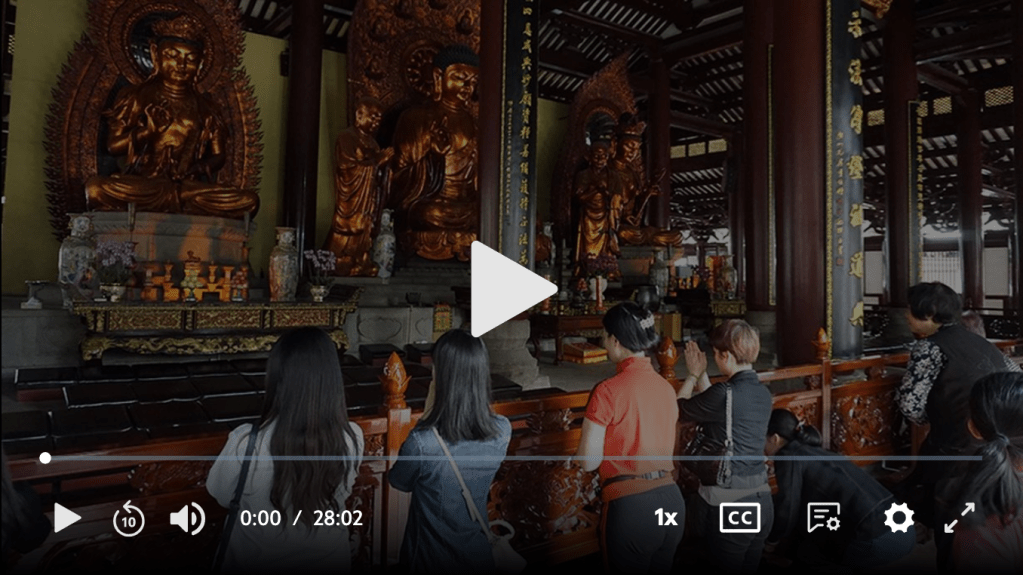
This special documentary explains the story of China and its maritime trade history. Beginning with the Qin and Han dynasties, China started its maritime trade because war violence made it harder to use the land routes. Using the sea routes to Persia, Africa, and the Middle East, China traded porcelain, tea, and silk in exchange for spices, ivory, and metals in the city of Guangzhou (Canton). With the rise of maritime technology, more travelers arrived in China, bringing with them different religions, such as Buddhism, Islam, and Christianity. During the Golden Age, under the Tang and Song dynasties, the rise of trade increased that China had to open a Bureau of Foreign Shipping in 1087 in the port city of Quanzhou. During this time, many foreign traders and clerics made Guangzhou and Quanzhou their new lasting home. Their tombstones and descendants are still around today.
Under the Ming Dynasty and its one-port mandate, all southern port cities besides Guangzhou were closed to foreign trade. In 1757, Guangzhou was the only port city opened for the new European and American traders, who wanted tea, porcelain and silk. At Guangzhou, huge storage facilities were built but were burned down due to the 1840 Opium Wars. Robert Morris, a British resident to Guangzhou, translated the first bible into Chinese and wrote the first Chinese-English dictionary. Since the 2000s, China has started a new economic project called “One Belt, One Road”, which was inspired by the old silk trade. From this project, many merchants from the old trading areas in Africa, the Middle East, Europe, Southeast Asia, and South Asia come to the Canton Fair to buy and be inspired by the new products sold there.
Although this video program did not go into specific details about the maritime trade, I did learn some interesting tidbits. One of them was the sea goddess, Mazu, who has no connection to any of the mainstream religions that were brought to Quanzhou. According to local folklore, Mazu was a Quanzhou resident who was respected in the community and swam well. After she died, the residents made her into a sea goddess and prayed to her for safe travels on the sea. Mazu is a reflection of how much the sea and maritime trade had on the lives of the Guangzhou and Quanzhou residents during Tang and Song dynasties. Another interesting tidbit is that because there was so much trade in Quanzhou, the Quanzhou government needed to open its first customs, which they named “Bureau of Foreign Shipping”, in 1087.
Although this informative program mostly focused on the maritime trade and its multicultural effects it had on Guangzhou, this informative program did provide important political, economical, and social background information about the Chinese maritime trade, the goods the country exported, and the legacy this maritime trade still has in present China. When Quanzhou was mentioned, the program explained that Quanzhou became the home of maritime trade foreign merchants and what they left behind were artifacts, buildings, and living descendants, who still reside in the city. The program also provided me with names of important government buildings and folklore religions to help me with my research.
Waves of Fortune: China’s Maritime Silk Road [Television series episode]. (2017, October 12). In Waves of Fortune: China’s Maritime Silk Road. Guangzhou, China: PBS.
 My Content Resources