
China Online Museum Presents Ceramics

Summary of Website

The curator of China Online Muslim talks about the history of Chinese ceramics. He/She first explains that ceramics have been an art form in China since the neolithic period. Each dynasty had its own particular type of ceramic. The Tang Dynasty invented “Sancai” or the “3-colored ware”, which was named after the three common glazes: yellow, green, and white. These colors came from metal oxides. For example, the green glaze came from copper while the yellow glaze came from iron. These ceramics were usually made as burial figurines for the aristocracy. Under the Song dynasty, various kilns had their own style of form and glaze. Song ceramics were simple in design and was considered high in quality, technique, and aesthetic. The Yuan Dynasty invented qinghua or “blue and white pottery”, which used a blue underglaze. Unlike the Song simplicity, Yuan ceramics were mass produced, thick, heavy, and large.

The Ming Dynasty perfected the Yuan’s blue and white ceramics as they developed innovations in porcelain production. For example, Dehua kiln in Fujian developed a high-quality pure white porcelain. Ming dynasty sold porcelain in a large scale to Europeans. The curator states that the quality of Ming porcelain is superior to that of any dynasty. Qing Dynasty rebuilt the Ming kilns that were destroyed during the Ming decline and continued the porcelain production.

Interesting Tidbits

During the earlier dynasties, kilns were located in the north. However, fleeing from civil war and the Yuans, many potters moved south and opened their own kilns. Dehua in Fujian province is one of those kilns. Also, the Jingdezhen province becomes the center of ceramics production. Under the Ming Dynasty, Jingdezhen played a huge role in porcelain since some of kilns were in charge of making the ceramics for the emperor. The curator also mentioned that when the Qing dynasty declined and China faced political instability, the quality of porcelain also declined. However, today, many newly established kilns are reproducing the traditional porcelain styles.

Connection to Guiding Questions

Ceramics or Chinese porcelain is one of the reasons why Quanzhou became a multicultural city. It was one of the biggest exports that China traded with its trading partners. Many of those partners sent out their traders, who decided to make Quanzhou their new home. By meeting with these traders, the decorative patterns mimicked the foreign trader’s culture and daily life. Later, under the Yuan Dynasty, the Persian traders brought colbalt to China. This metal later became the blue dye in qinghua porcelain, a porcelain that was made popular by Yuan Dynasty. It continued to be popular under the Ming, who traded this porcelain with the Europeans. That’s why porcelain is also called “China” because it came from China or in this case “Global China”.

Yibo, Y. (2006). Ceramics. China Online Museum. Retrieved 2020, from https://www.comuseum.com/ ceramics/
The Golden Age of Maritime Trade by Lincoln Paine

Summary of Chapter

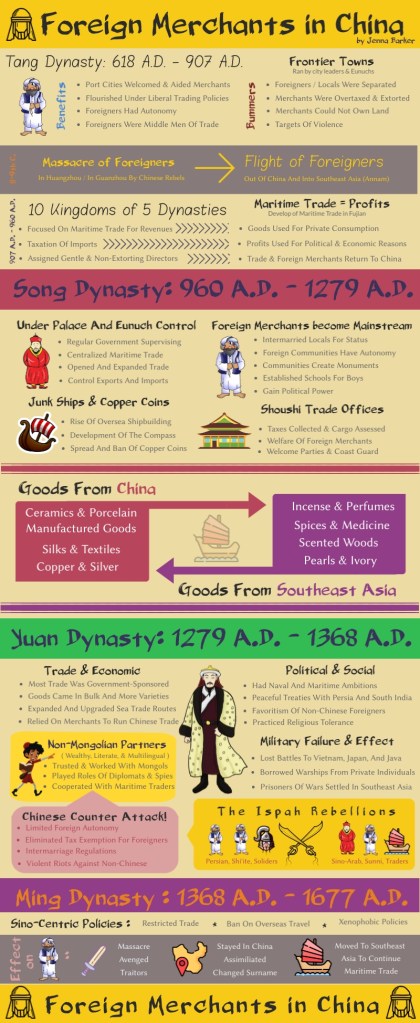
In this chapter, Lincoln Paine (2013) describes the further rise of maritime trade in Quanzhou during the Yuan Dynasty and its decline during the Ming Dynasty. After helping the southern Song government defeat the northern Jin government, the Mongols attacked the Songs, but their horses were no match for Song warships. Once the Mongolian leader, Kublai Khan, adapted his forces for naval combat, he defeated the Songs and founded the Yuan Dynasty. As leader, Kublai Khan had bold maritime ambitions so he increased the naval army and developed maritime trade in the region. For his naval army, he demanded 2000 ships to be built, which decreased the amount of timber in China. To increase trade, he aimed to conquer Korea, Japan, and Java, but only was successful in conquering Korea. His defeat in Java lost him 20,000 Chinese sailors, who remained in Southeast Asia as prisoners of war. For trade, he improved navigation, dredged channels, built more warehouses, docks, and anchorages; erected lighthouses, and developed safer sea routes. His government lent ships to foreign merchants and split the profits 70:30. The government, of course, getting the higher share. From this rapid expansion of trade, navigational practices, including the early form of the compass and seaway charts, emerged.

In 1330s, the Yuan dynasty faced famine, plague, and repeated flooding, and therefore, was replaced by the Ming Dynasty. The Ming Dynasty’s leaders were native Chinese and sought a Sino-centric path. Under Taizu Ming, China prioritized border defense and protection against pirates over maritime trade. As Neo-Confucian believers, he and the Ming Dynasty did not prioritize technological advances in shipbuilding or sea navigation, financial institutions, or the legal protection of private property. Instead of open foreign trade, they focused on increasing Chinese prestige overseas. To encourage tributes to the emperor and eliminate trade competition with expatriate Chinese, the emperor sent Zheng He, a Muslim eunuch, and a fleet of hundred ships around the Indian Ocean. Zheng He went on many voyages. Although China was excited about Zhang He’s victory over pirates during his first voyage, they grew bored by his last voyage because China was too busy dealing with domestic issues, such as river floods, epidemics, currency depreciation, and preoccupied armies. In the 1430s, the Ming government prohibited Chinese ships and sailors from overseas travel, stopped building ships for overseas voyages, and abandoned coastal defense. Due to the decrease of oversea trade, many Chinese traders from Quanzhou abandoned China and moved permanently to Southeast Asia.

Interesting Tidbits

Before the Yuan Dynasty, Quanzhou was a multicultural city with foreign communities. According to written documents by visitors, the foreigners were split between the fair-skinned (Arabs and Persians) foreigners and the dark-skinned (Southeast Asian and Indian) foreigners. Second, Lincoln Paine points out that in 1292 Kublai Khan sent a Yuan princess (with 14 ships and Marco Polo) to Persia to wed a Persian prince, not by land – the typical Mongolian way- but by sea. Marco Polo reported this in his book, The Travels. Although China grew bored of oversea trade, the Zhang He’s voyages encouraged local rulers to start minting their own coins and adopt a coin/cash economy.

Connection to Guiding Questions

This chapter claims that Quanzhou’s multiculturalism supported its growth as well as its decline. Since the leaders of Yuan Dynasty were Mongols, their dynasty encouraged religious tolerance, overseas trade, and naval expansion. Because they had previous work experience with Arab-Persians, the Mongolian rulers favored foreign merchants over the Han Chinese, and gave them political, military, and economic power to rule over Quanzhou. After the Ming Dynasty retook China from Mongolians, they wanted China to go back to its “Chinese” ways, or in their case, Neo-Confucian ideals. They pretty much wanted to “Make China Great Again”. As a counterattack against the open trade policy of the Yuan Dynasty, the Ming Dynasty stopped overseas trade, alienated maritime merchants, and ignored their naval defense. Due to these trade restrictions, Quanzhou stopped being a major port city and many of its residents either moved to Southeast Asia to trade or moved to the mountains to farm. This chapter really paints a picture on how government policies can impact positively and negatively on international trade and cultural diversity in a region.

Paine, L. (2013). The golden age of maritime trade. In The Sea and Civilization: A Maritime History of the World (pp. 346-375). Random House.