What is it?
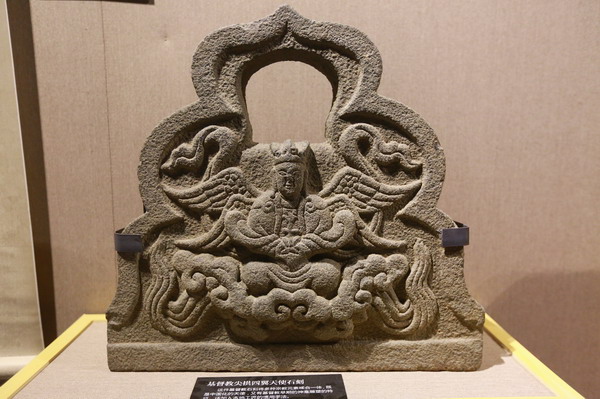
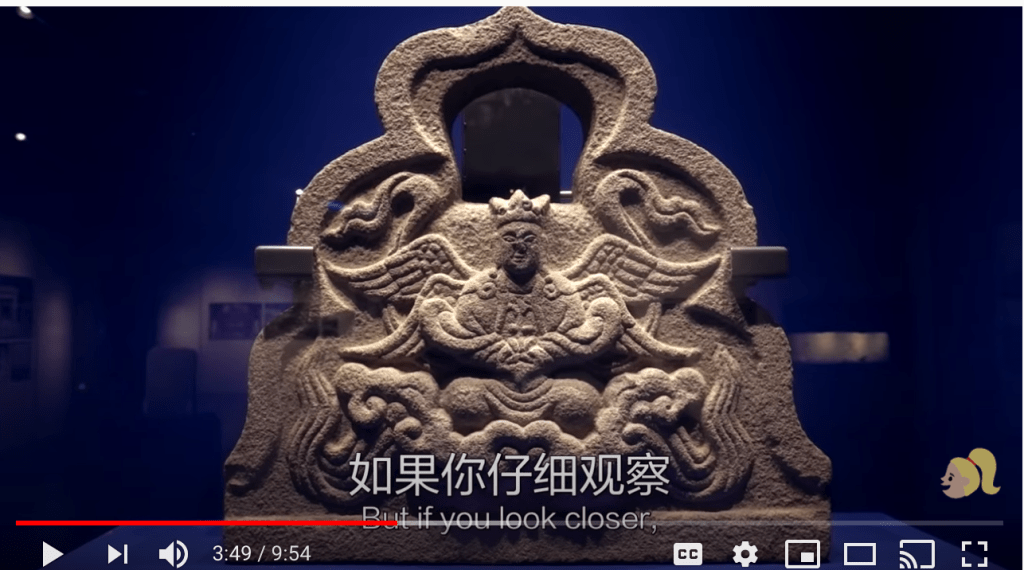
In the Quanzhou Maritime Museum in Quanzhou city, you can see a Nestorian Christian tomb carving that is nicknamed “The 4-Winged Angel”. It is an angel with 4 wings, wearing Mongolian-style clothing. The crown the angel wears is a Buddhist motif. The clouds the angel sits on are the auspicious clouds from Taoism. He also holds a lotus, which is a motif that is linked to both Hinduism and Buddhism. This tombstone was found in Quanzhou city. This carving demonstrates how Quanzhou integrated the religions and cultures of their residential foreign merchants into their local culture.
Interesting Tidbit
One staff member at the Quanzhou Maritime Museum explains that having a combination of different religious motifs in one carving was quite rare for China and the ancient world. However, for Quanzhou, this was a regular occurrence because Quanzhou has been a religiously diverse city and its people have been open to new ideas since the tenth century.
Connection to Guiding Questions
This carving demonstrates that foreigners and the religions they brought influenced the local culture of Quanzhou. Before Quanzhou became a multicultural trade city, Quanzhou and the rest of China had Taoism and Buddhism, but during the maritime trade era, Quanzhou welcomed foreign clerics and merchants, and allowed them to practice their religions in peace. However, it could be said that they did more than just “allow” religious tolerance. From looking at this artifact and many others, Quanzhou residents integrated these foreign religious motifs and beliefs into their own customs. Now, Quanzhou city is still considered a religious and cultural diverse city, and the locals are quite proud of that.
Li, S. (2014, December 14). [The Christian stone carving featuring a winged angel from the Quanzhou Maritime Museum]. China Daily. http://www.chinadaily.com.cn/m/fujian/images/attachement/jpg/ site1/20141218/eca86bda385d15fcc53f1c.JPG


 My Content Resources